Comparison
De'Longhi vs Philips: Which First Superautomatic?
Buy the Philips 3200 LatteGo for the cheapest, easiest milk drinks. Buy the De'Longhi Magnifica Evo for iced coffee, a steam wand option or a slimmer body.
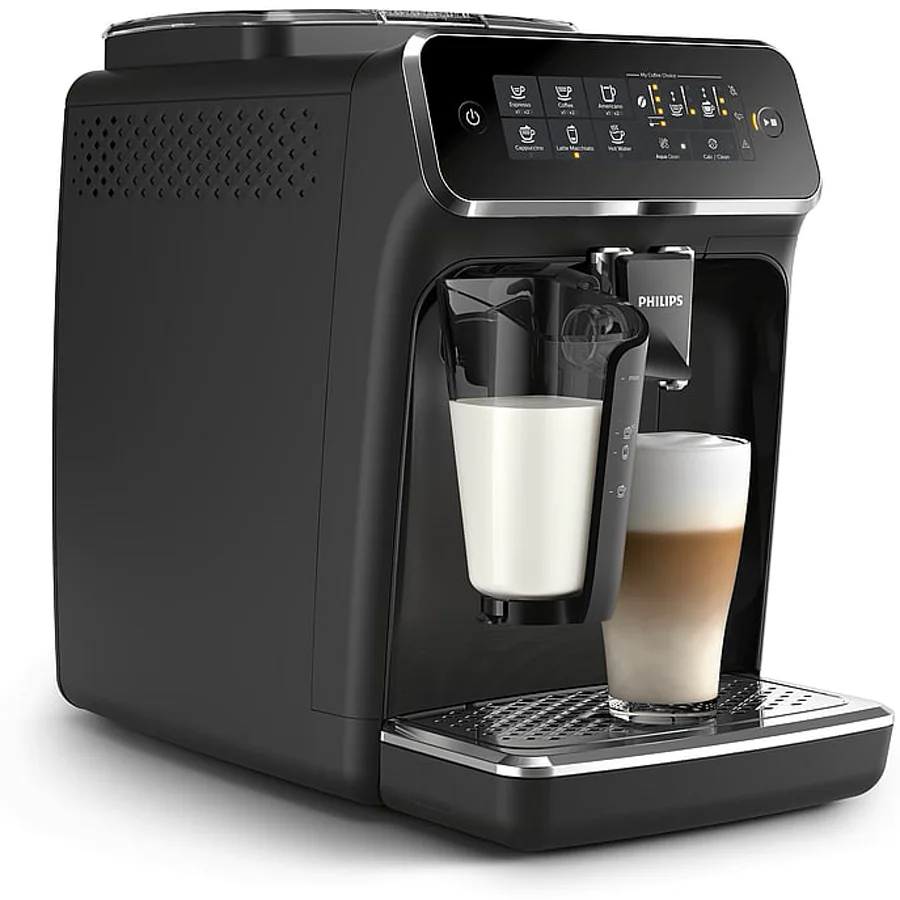
Philips 3200 LatteGo
One-touch cappuccinos from a two-part milk system with no tube.
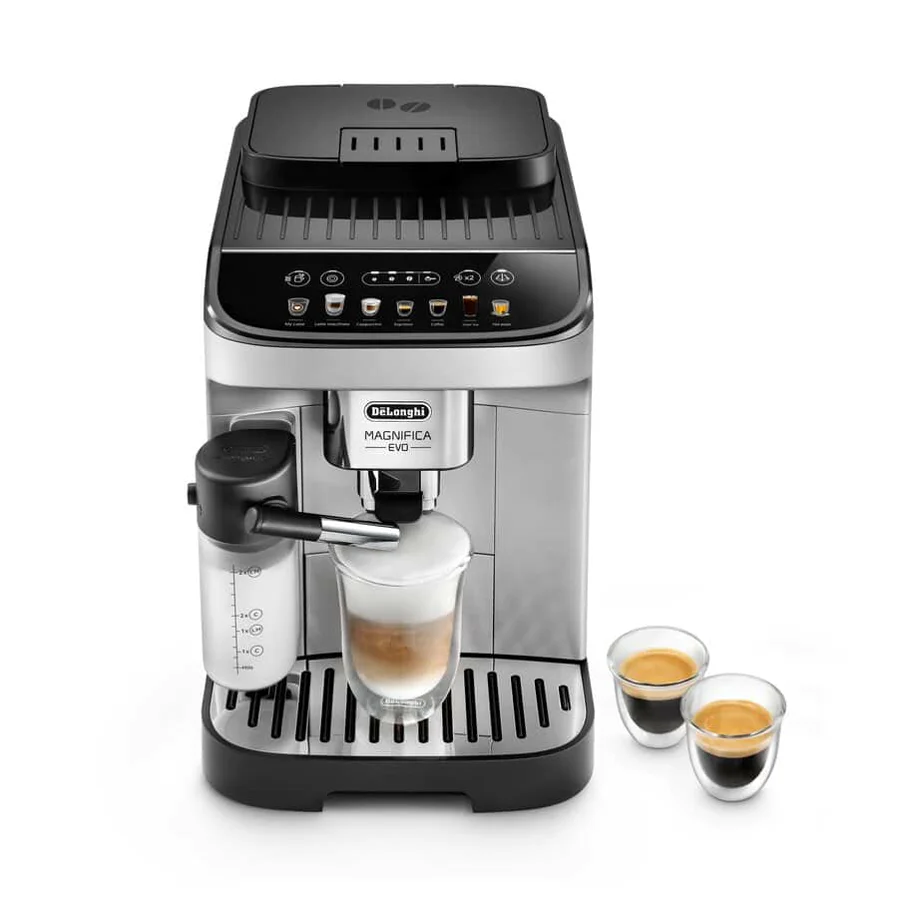
De'Longhi Magnifica Evo
An Iced Coffee button, a slimmer body and a steam wand version.
If you want one-touch cappuccinos for the least money and the fastest milk cleanup, buy the Philips 3200 LatteGo, an estimated $450 to $600. If you want an Iced Coffee button, a cheaper steam wand version or a slightly narrower machine, buy the De’Longhi Magnifica Evo, about $500 to $750 with a wand or about $600 to $900 with the LatteCrema carafe. Both make good everyday coffee from fresh beans, and both ask you to rinse the brew unit each week.
Is this you?
| If this sounds like you | Buy |
|---|---|
| You drink a cappuccino or latte macchiato most days and hate washing milk parts | Philips 3200 LatteGo |
| You want to spend the least on a first superautomatic with milk | Philips 3200 LatteGo, on sale |
| You drink mostly black coffee, or want to learn to steam milk | Magnifica Evo with steam wand (ECAM29043SB) |
| You want one-touch milk drinks plus an Iced Coffee button | Magnifica Evo LatteCrema (ECAM29084SB) |
| Your counter space is tight by fractions of an inch | Magnifica Evo (9.45 in wide) |
Key takeaway: the real split is milk cleanup against menu options. The Philips LatteGo has two parts and no tube. The De’Longhi gives you Iced Coffee and a wand version, but its carafe takes longer to clean.
Side by side
| Philips 3200 LatteGo (EP3241/54) | De’Longhi Magnifica Evo (ECAM29084SB / ECAM29043SB) | |
|---|---|---|
| Price band | Est. $450 to $600 (list about $800) | About $600 to $900 (LatteCrema), $500 to $750 (wand) |
| Milk system | LatteGo, 2 parts, no tubes, 0.26 L jug | LatteCrema carafe with tube and spout, or manual steam wand |
| Drinks | 5 coffees plus hot water | 7 recipes (LatteCrema) or 6 (wand), both with Iced Coffee |
| Grinder | Ceramic, 12 settings | Conical burr, 13 settings |
| Pump | 15 bar | 15 bar |
| Controls | Touch display, 3 strength levels | Soft-touch icon panel, strength and volume per drink |
| User profiles | None | None |
| Brew unit | Removable; rinse weekly, grease on schedule | Removable; rinse weekly |
| Water tank | 1.8 L | 1.8 L (60 oz) |
| Bean hopper | 275 g | 250 g |
| Width | 9.7 in | 9.45 in |
| Weight | 17.6 lb | 20.8 lb (wand), about 21 lb (LatteCrema) |
The two machines are close on size, tank and pump. The differences that change your mornings are the milk system, the drink list and the price you pay on the day.
Milk drinks
The LatteGo jug clips to the front, and milk flows from the jug into a frothing chamber with no tube. Press Cappuccino or Latte Macchiato and the drink lands in the cup. The jug holds 0.26 L, enough for about two cappuccinos, so a family making four drinks refills it mid-morning.
The Magnifica Evo LatteCrema carafe draws milk through a tube and spout, then runs a short clean cycle after each milk drink. You store the carafe in the fridge between drinks. It adds one-touch Cappuccino and Latte Macchiato to the Evo’s menu.
The wand version makes no one-touch milk drinks. You hold a pitcher under the wand and texture the milk yourself, which takes a minute or two and some practice. In return you control the foam texture. Neither machine makes cold foam.
Espresso and coffee strength
Owners commonly describe the Philips espresso as decent and a little thin next to pricier machines, and good under milk. The Magnifica Evo gets similar reports: good everyday espresso with a light crema. Neither one wins clearly on taste in owner reports, so do not pick on espresso alone.
The Philips offers 3 strength levels and builds its Americano by adding hot water after a shot. A ground-coffee chute takes one scoop of pre-ground decaf. The Evo lets you set strength and volume per drink, and its Iced Coffee button brews a stronger coffee meant to go over ice. That is hot coffee on ice, not cold brew.
Barista tip: change the grind only while the grinder runs, one step at a time, and judge after two or three drinks. Go finer for more body until the flow slows too much.
Daily cleaning and upkeep
This is where the Philips earns its place. Rinsing the two LatteGo parts takes under a minute, and Philips lists them as dishwasher safe. The LatteCrema carafe needs a daily wash of its parts after the clean cycle. Owners trace most LatteCrema foam complaints to milk residue left in the tube or spout. Our milk system care guide covers both routines.
Both machines share the same weekly job: slide the brew unit out of the side door, rinse it under warm water without soap, let it dry and put it back. The Philips adds one more task. Its manual asks you to grease the brew group on a schedule, about every couple of months, with the lubricant in the box. Skipped grease is a common reason a Philips brew group starts to squeak or stick.
Both machines empty into a drip tray and grounds container that you clear every day. Both come out from the front, so you can tuck either machine into a corner.
Size and noise
The machines are almost the same footprint. The Philips is 9.7 x 14.6 x 17 in (W x H x D), and the Evo is 9.45 x 14.17 x 17.32 in. Both fill beans from the top, so leave a few inches under wall cabinets or slide the machine forward to add beans.
The Philips spout moves from 3.3 to 5.7 in, so most 12 oz mugs fit. We found no comparable decibel figures from either maker, so we do not rank them on noise. On both, the grinder is the loudest part.
Cost of ownership
The Philips usually costs less up front. It lists at about $800, but it often sells for an estimated $450 to $600, and Amazon price history shows dips near $400. Set a price alert. The LatteCrema Evo band starts higher, so the honest answer to “should I pay more for De’Longhi?” is yes only if you want Iced Coffee or the Evo’s narrower body.
Philips 3200 LatteGo: one-touch cappuccinos with a two-part milk system you rinse in under a minute.
Check price →Running costs are close. The Philips accepts an AquaClean filter, and Philips says you can make up to 5,000 cups without descaling if you change the filter when the machine asks. Filters, milk cleaner and degreasing tablets are its main supplies. For the Evo, plan for an estimated $40 to $70 a year in descaler, an optional filter and milk cleaner. Neither brand needs brew unit cleaning tablets, because you rinse the unit by hand.
Our Magnifica Evo review explains how to tell the two Evo versions apart on a listing. “43” at the end of the model number means the wand; “84” means LatteCrema.
De'Longhi Magnifica Evo LatteCrema: one-touch milk drinks plus an Iced Coffee button, in a 9.45-inch-wide body.
Check price →The step-ups
Both brands sell larger models with the same milk idea. The Philips 5500 LatteGo (EP5547/90) offers 20 coffee recipes, including iced coffee, per Philips US, and keeps the two-part LatteGo. On the De’Longhi side, the Dinamica Plus adds a color touch screen and user profiles, for an estimated $1,200 to $1,700. The Eletta Explore, about $1,800 to $2,000, is the one to buy for cold foam.
For a first machine, start with the 3200 or the Evo. Step up only if several people want saved drinks or you drink iced lattes most days.
Who should buy neither
- You want to control every shot. A superautomatic picks dose and timing for you. Look at our best semi-automatic espresso machines and budget for a grinder.
- You drink iced lattes with cold foam most days. Neither machine makes cold foam. Read our Eletta Explore review.
- You will never rinse a brew unit. Both of these need a weekly rinse. A fixed brew unit costs much more; our Jura vs De’Longhi comparison shows what that buys.
How we chose
We did not use these machines ourselves. We compared manufacturer specifications, manuals and long-term owner reports, and the questions first-time buyers ask most often in owner forums. We checked US prices in November 2026 against our price bands. Where we could not confirm a spec, such as noise levels or the Evo’s maximum cup height, we left it out.
FAQ
Is the Philips 3200 or the Magnifica Evo better for a beginner?
For milk drinks, the Philips 3200 LatteGo. Its milk system is the easiest to clean. For mostly black coffee, the Magnifica Evo wand version costs less than the LatteCrema model.
Should I pay more to get De'Longhi instead of Philips?
Only for a feature you will use. The Evo adds an Iced Coffee button and a slightly narrower body. Espresso quality is close in owner reports.
Which one is easier to clean?
The Philips, for milk. The LatteGo has two parts and no tube. Both need a weekly brew unit rinse, and the Philips also needs grease on a schedule.
Do either of them make cold foam?
No. Both make hot milk drinks only. The De’Longhi Eletta Explore is the cold foam machine.
Still deciding?
Take the espresso machine finder quiz to match a machine to your drinks and budget.