Maintenance
Espresso Machine Water Filters: Do You Need One?
Test your water hardness first. Above about 7 grains per gallon a softening filter saves descaling work; in soft water a taste filter or no filter is fine.
Test your water before you buy a filter. As an estimated rule of thumb, if your hardness is above about 7 grains per gallon (120 ppm), a softening filter in the tank saves you descaling work and protects the heater. Between 3 and 7 gpg it still helps. If your water is soft and tastes clean, you can skip the filter and descale on schedule. If it tastes of chlorine, a simple taste filter helps the cup but does little for scale.
When a filter helps and when it does not
| Your water | Filter advice (estimated guide) | Why |
|---|---|---|
| Soft, 0 to 3 gpg, tastes clean | Optional | Scale forms slowly; descaling an estimated every 5 to 6 months is easy |
| Soft, tastes of chlorine | Taste filter (carbon) | Chlorine hurts flavor more than the machine |
| Moderate, 3 to 7 gpg | Softening filter helps | Stretches the time between descales |
| Hard, 7 gpg and up | Softening filter strongly recommended | Without one you descale an estimated every 4 to 10 weeks |
| Whole-house softener installed | Usually no tank filter needed | Scale minerals are already removed |
| Distilled or RO water only | Do not use alone | Many machines need some minerals to work |
The descale intervals in the table are estimates from our descaling schedule, which gives a full row for each hardness band. Your machine’s prompt or manual overrides them.
How to test your water hardness
You have two easy options. Use both if the results seem off.
- Read your utility’s water report. Every US water utility publishes an annual Consumer Confidence Report. Look for “total hardness.” Values in mg/L are the same as ppm.
- Dip a test strip. Hold a water hardness test strip in cold tap water for a second, wait, and match the color to the chart. Jura puts one strip in the box with each machine. You then enter the result in the machine’s menu.
Hardness comes in three units. Convert them like this:
| Unit | Equals |
|---|---|
| 1 grain per gallon (gpg) | about 17.1 ppm |
| 1 German degree (°dH) | about 17.8 ppm, or about 1 gpg |
| 1 mg/L | 1 ppm |
Jura and other European brands use °dH in their menus. US reports usually use ppm or gpg. Because 1 °dH is close to 1 gpg, you can enter a gpg reading almost directly.
Test again if you move, if your utility changes its source, or if you install a softener.
Softening filters vs taste filters
Two different jobs get sold under the word “filter.”
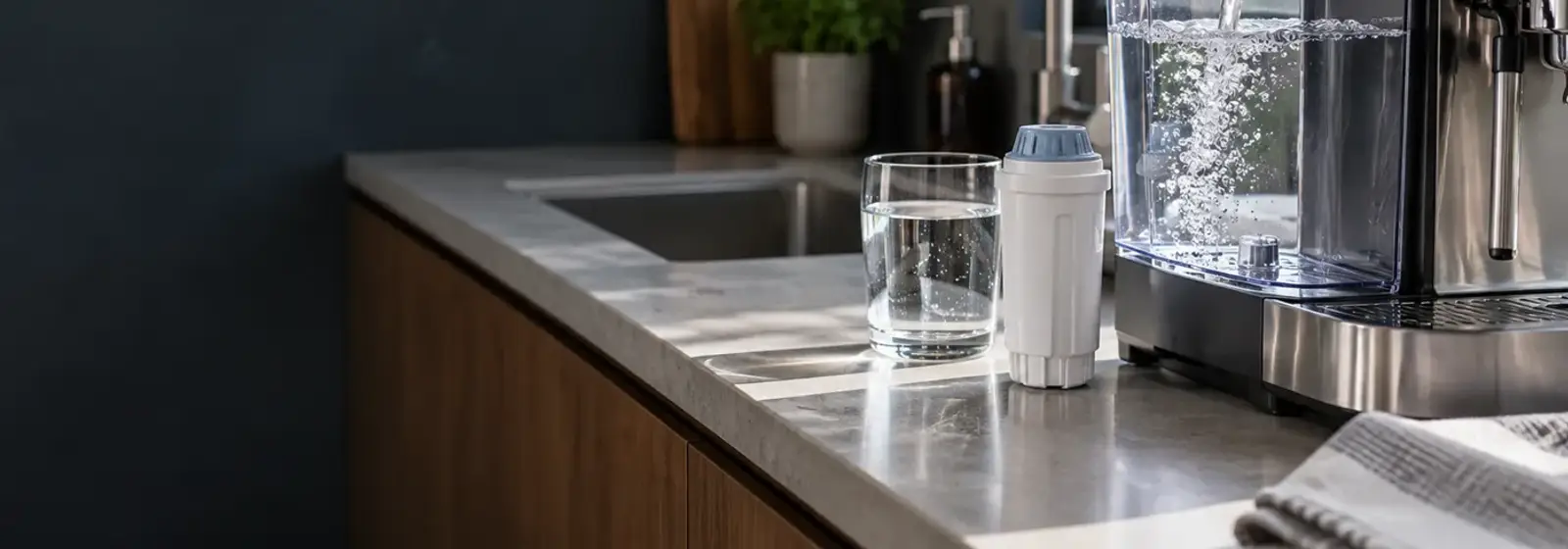
Softening filters use an ion exchange resin. The resin traps calcium and magnesium, the minerals that form scale, before the water reaches the heater. Most espresso machine tank cartridges, including Jura’s CLARIS and Philips’ AquaClean, combine this resin with activated carbon.
Taste filters use activated carbon only. Carbon removes chlorine and some odors. It does almost nothing to hardness, so scale still forms at the same rate.
| Filter type | Reduces scale | Improves taste | Where it sits |
|---|---|---|---|
| Brand tank cartridge (CLARIS, AquaClean) | Yes | Yes | Inside the water tank |
| Pitcher filter | Partly | Yes | You fill the tank from the pitcher |
| Carbon-only filter | No | Yes | Faucet or under the sink |
| Whole-house salt softener | Yes | Can taste flat | On the main water line |
A salt softener swaps calcium and magnesium for sodium. Scale stops, but very soft water lacks the minerals that help extraction, and some owners find the coffee tastes flat. If you have one, a pitcher of unsoftened, carbon-filtered water for the machine is a fair compromise.
Brand filters for superautomatics
Jura. Jura’s manuals recommend a CLARIS filter when your hardness is 10 °dH or more. Current manuals, such as the J6 and J8, say the machine no longer has to be descaled while a CLARIS Smart cartridge is in use. Change it when prompted. The current CLARIS Smart+ cartridge fits the current E, S, J and Z models, including the machine in our Jura E8 review. The machine reads a chip in the cartridge and tracks its life. Older Impressa models use the CLARIS Blue, which is not interchangeable. This Jura CLARIS filter guide lists which cartridge fits each older model.
Jura CLARIS Smart+: the softening cartridge for current Jura machines. Change it when the display asks, and Jura's manuals say the machine needs no descaling.
Check price →Philips. The AquaClean filter ships with LatteGo models such as the one in our Philips 3200 LatteGo review. Philips says you can make up to 5,000 cups without descaling if you replace the filter each time the machine asks. Activate the filter in the menu after you fit it.
De’Longhi, Miele and others. Most superautomatics take a brand cartridge in the tank. Fit it, register it in the menu, and change it when prompted or by the date in the manual.
Filters for semi-automatic and lever machines
Breville. Machines like the Breville Barista Express come with a filter holder and cartridge for the tank. The Barista Express manual says to set the date dial on the holder 2 months ahead, so you replace the cartridge every 2 months. Some newer Breville models use 3 months, so check your manual. Soak a new cartridge in water for 5 minutes before you fit it.
Single boilers, heat exchangers and dual boilers. Many of these machines ship without a tank filter, and a full boiler descale on them is a big job. Many owners use a pitcher filter or bottled water with moderate minerals to keep scale low. Our guide to boilers and pressure explains why scale on a boiler element or level probe is harder to fix than in a thermoblock.
Lever machines. La Pavoni publishes no hardness target. Filtered tap water that tastes clean, or a bottled water that is not very hard, is the usual advice. This guide to water for a La Pavoni covers the distilled water debate for these boilers.
Why not just use distilled water?
Distilled and reverse osmosis water contain almost no minerals. They stop scale, but they bring other problems:
- Many boiler machines use a level probe that senses water through its minerals. With pure water, the probe can fail to detect the boiler level.
- Coffee extracted with mineral-free water often tastes flat.
If you want very low scale, use a softening filter or a remineralized water made for coffee, not plain distilled.
How long filters last and what goes wrong
A filter only protects the machine while its resin has capacity. When it is spent, scale forms as if no filter were there. Three rules cover most problems:
- Tell the machine you use a filter. Superautomatics change their descale counter when a filter is active. If the filter is in but not registered, you get descale prompts you do not need.
- Tell the machine when you stop. If you remove the filter but leave it registered, the counter waits too long and scale builds up.
- Change it on time. Follow the machine prompt or the manual’s interval. Write the date on the holder if your machine does not track it.
Always remove the filter before you descale. Descaler damages the resin.
FAQ
Does a water filter replace cleaning? No. A filter reduces scale. Coffee oil still builds up in the brew path, so follow our cleaning routine as well.
Can I use a pitcher filter instead of the brand cartridge? Yes, on most machines. It reduces scale less than a fresh brand cartridge. Leave the machine set to “no filter” so its descale counter stays correct.
Do I need a filter with soft water? No. If your water tests under 3 gpg and tastes clean, descale on the soft-water schedule and save the cartridge cost.