Comparison
Barista Express vs Barista Pro: Is the Upgrade Worth It?
Buy the Barista Express for the lowest-cost all-in-one. Pay about $150 more for the Barista Pro if you want a 3-second heat-up, 30 grind steps and quick steam.
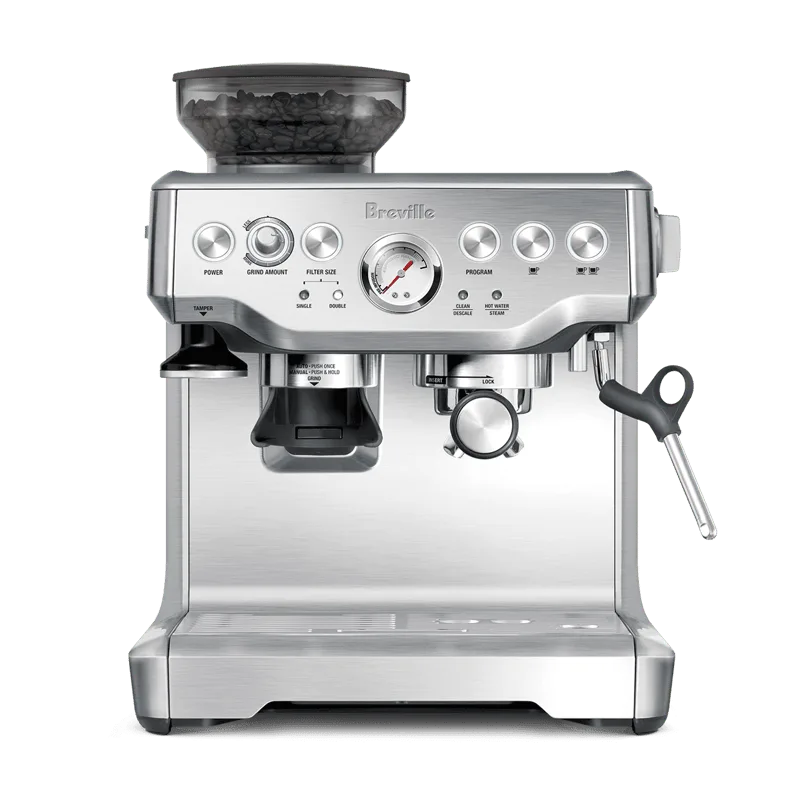
Breville Barista Express
Grinder, pressure gauge and steam wand in one box for one or two drinks a day.
Breville Barista Pro
A 3-second ThermoJet heater, 30 grind settings and a quick switch to steam.
If you make one or two drinks a day with medium or dark roasts, buy the Breville Barista Express (BES870XL). It lists at about $700 and usually sells for an estimated $550 to $700. If you drink light roasts, make milk drinks back to back, or hate waiting for a machine to warm up, buy the Breville Barista Pro (BES878). It lists at about $850 and usually sells for an estimated $600 to $850.
We compare manufacturer specifications, manuals, retailer listings and long-term owner reports. We do not claim hands-on use.
Is this you?
| If this sounds like you | Buy |
|---|---|
| This is your first espresso machine and you want the lowest price for a grinder in the box | Barista Express |
| You drink medium and dark roasts, mostly straight or one latte a day | Barista Express |
| You buy light roasts from a local roaster | Barista Pro |
| You make two or more milk drinks in a row | Barista Pro |
| You want coffee within a minute of switching on | Barista Pro |
| You like watching a pressure gauge while you learn | Barista Express |
| You want a longer US warranty | Barista Pro |
Key takeaway: both machines share the same workflow, 54 mm portafilter and built-in conical grinder. The Pro buys you speed and finer grind steps. If neither matters to you, the Express does the same job for less.
Side by side
| Breville Barista Express (BES870XL) | Breville Barista Pro (BES878) | |
|---|---|---|
| Price band | List about $700, est. $550 to $700 | List about $850, est. $600 to $850 |
| Heater | Thermocoil with PID | ThermoJet with PID, about 3 seconds to temperature |
| Grinder | Conical burr, 16 settings | Hardened steel conical burr, 30 settings |
| Bean hopper | 1/2 lb (about 250 g) | About 250 g |
| Pump | 15 bar, low-pressure pre-infusion, then 9 bar | 15 bar, low-pressure pre-infusion, then 9 bar |
| Portafilter | 54 mm | 54 mm |
| Shot feedback | Analog pressure gauge | LCD with shot timer and grind setting |
| Milk | Manual steam wand | Manual steam wand |
| Hot water outlet | Yes | Yes |
| Water tank | 67 oz (about 2 L) | 67 oz (about 2 L) |
| Size (Breville listing) | 15.9 x 13.1 x 12.4 in | 16.1 x 13.8 x 13.1 in |
| US warranty | 1 year | 2 years |
Baskets, tampers and milk jugs for one fit the other.
Heat-up and steam: the biggest daily difference
The Express heats water with a Thermocoil, a coiled metal block. Breville does not publish a heat-up time for it. Owners commonly let it warm for several minutes and pull a blank shot so the group and portafilter are hot. After a shot, the Thermocoil has to climb to steam temperature, so you wait and purge water from the wand first. After steaming, you run water through the group to cool it before the next shot.
The Pro uses Breville’s ThermoJet, which Breville says reaches extraction temperature in about 3 seconds. The same fast heater switches between brewing and steaming much more quickly. You still cannot brew and steam at the same time, but the gap between the shot and the milk shrinks from a wait to a pause.
For one drink a day, this barely matters. For two lattes every morning, it does. If you make four or more milk drinks in a row, neither is ideal; our Barista Express vs Dual Boiler comparison covers the machine that brews and steams at once.
Breville Barista Pro: a 3-second heat-up, 30 grind settings and a quick switch to steam, with the grinder in the box.
Check price →The grinder: 16 steps vs 30
The grinder is the second reason to upgrade. The Express has 16 settings. With medium and dark roasts, one of the middle settings usually works. With light roasts, owners commonly report that one step runs too fast and the next chokes the machine. Breville’s manual describes an internal burr adjustment that moves the whole range finer, which helps some owners.
The Pro has 30 settings on hardened steel conical burrs. Nearly twice the steps means smaller jumps between them, so you can land closer to the shot time you want.
Neither grinder matches a good standalone espresso grinder. If you already own one, you pay for a grinder you will not use. In that case, read our espresso grinder guide and look at a machine without a built-in grinder.
Display and controls
The Express has a large analog pressure gauge with a marked espresso range. It tells you at a glance if the grind is too fine or too coarse.
The Pro drops the gauge for an LCD. It shows a shot timer and the grind setting. A timer is the more useful number once you weigh your shots with a scale. Both machines offer 1-cup and 2-cup volumetric buttons, plus a manual shot you stop yourself.
Size, tank and counter fit
Breville lists the Express at 15.9 x 13.1 x 12.4 in and the Pro at 16.1 x 13.8 x 13.1 in. The Pro is under an inch bigger on each measure. The tallest measure on both includes the bean hopper on top, so check the space under your upper cabinets.
Both tanks hold about 67 oz and both hoppers about half a pound of beans. Both tanks lift out, so leave room to reach them.
Cleaning and upkeep
The daily routine is the same: knock out the puck, rinse the basket, purge and wipe the wand, empty the drip tray. Both run a cleaning cycle with a disc and a tablet when the machine asks.
Both heaters have a narrow water path, so scale is the main long-term risk. Use the water filter in the box and descale on schedule. Our descaling guide sets the interval by water hardness. A 54 mm tamper is the common first upgrade on either machine.
Price and deal season
Breville lists the Express at about $700 and the Pro at about $850, a gap of about $150. Both often sell below list, and the gap between them moves with each sale. A Pro sale price close to the usual Express price makes the Pro the easy choice. Our Black Friday espresso machine guide lists the normal price bands, so you can tell a real discount from a routine one.
The Pro’s 2-year US warranty, against 1 year on the Express, is part of the value. Buy from a seller that honors Breville’s US warranty, and register the machine.
Breville Barista Express: grinder, pressure gauge and steam wand in one box, for the lowest all-in-one price.
Check price →What about the Barista Express Impress?
Breville also sells the Barista Express Impress (BES876), listed at about $800. It keeps the Thermocoil heater, so it does not fix the Express’s wait for steam. It adds 25 grind settings and an assisted tamping lever that Breville says applies 22 lb of force with a 7° twist. It also adjusts the next dose from the last one. Buy it only if tamping and dosing worry you more than heat-up time.
Who should not buy each
Skip the Barista Express if:
- You drink light roasts and want fine grind steps.
- You make two or more milk drinks back to back every day.
- You want more than a 1-year US warranty.
Skip the Barista Pro if:
- You make one drink a day with medium or dark roasts. The Express does the same job for less.
- You already own a good espresso grinder.
- You want hands-free milk. Neither machine textures milk for you; see our Bambino Plus vs Barista Express comparison.
Our Barista Express review covers the Express in more detail, and our Breville brand guide maps the full range.
How we chose
We did not use these machines ourselves. We compared Breville product pages, retailer listings and long-term owner reports, and checked US list prices in November 2026. We left out specs we could not confirm for both models, such as weight and US wattage.
FAQ
Is the Barista Pro worth about $150 more than the Express?
Yes, if you drink light roasts or make two milk drinks in a row. The fast heater and 30 grind steps fix the Express’s two main limits. For one medium-roast drink a day, the Express is the better value.
Do the two machines make different espresso?
Not by design. Both use a 15-bar pump with pre-infusion, PID control and the same 54 mm basket. The Pro’s finer grind steps make it easier to dial in a good shot, mostly with light roasts.
Does the Barista Pro have a pressure gauge?
No. It has an LCD with a shot timer and the grind setting. The Express has the analog gauge.
Do Barista Express accessories fit the Barista Pro?
Yes. Both use a 54 mm portafilter, so baskets, tampers and dosing funnels fit both.